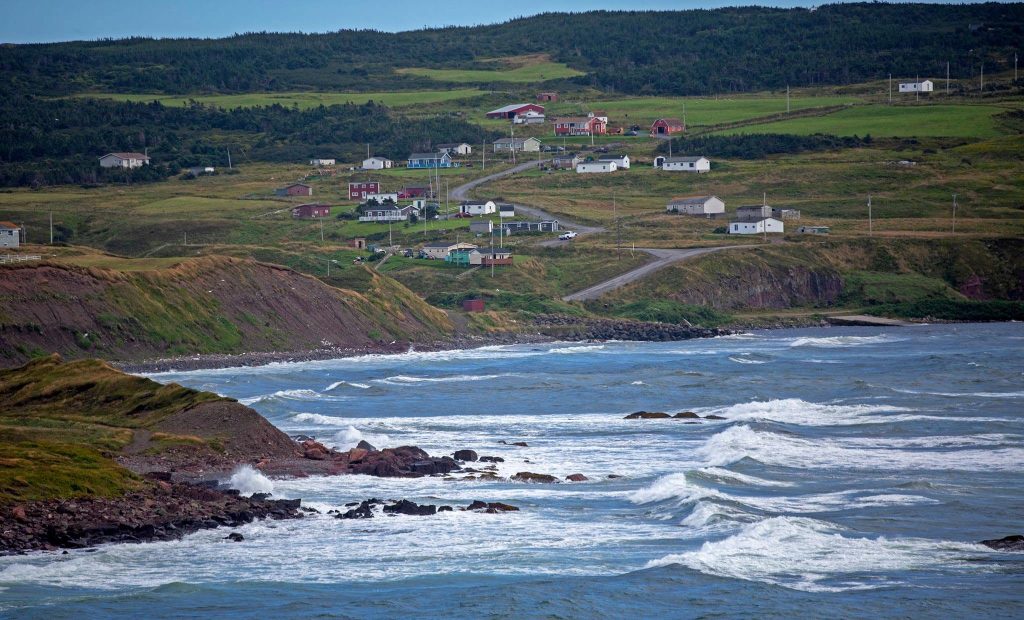
St. Bride’s is a small, scenic community located on the southwestern Avalon Peninsula of Newfoundland and Labrador, bordering the eastern side of Placentia Bay. It is renowned as the gateway to the Cape St. Mary’s Ecological Reserve, a world-famous bird sanctuary, offering dramatic coastal scenery, fishing history, and a quiet coastal lifestyle
Story provided by: Mr. Pat McGrath
Another little bit of history about St. Bride’s.
Before the 1700’s the French (Basques), built stages near Cape St. Mary’s to salt their fish and then it was brought to Placentia to dry. This is where La Stresse came from. Then an English corruption of the word became Distress, which was changed to St. Bride’s in the 1870’s, because the Parish Priest at the time didn’t think it was an appropriate name.
The first resident priest was an Irishman named father Edward Martin who is buried in the old graveyard in St. Bride’s.
The first residents were Doheys and Conways. A Mr. Conway was the first teacher, who was a fisherman that was advanced enough to teach school. In the early years students used sharp stones to write on their slates, while teachers gathered birch rinds to use as a substitute for paper.
Conways were the first there, who settled on the south side and the Doheys came next and settled on the north side. The first census of 1836 list 39 people in St. Bride’s.
There was a small river that separated both sides of St. Bride’s and those families. The location of the harbour and fishplant in St. Bride’s today, on the south side was where the Conways fished, while the Doheys fished out of Deadman’s Cove, on the north side.
Other early families that came to St. Bride’s were Foley, Lundrigan, Murphy, White, and Young. All of those names still exist today.
 History of St. Mary's Bay and surrounding Communities